ETFE (Ethylene-Tetrafluoroethylene Copolymer) is a special engineering material in the fluoroplastic family with high light transmittance, excellent toughness, weather resistance and corrosion resistance. It achieves a light transmittance of over 90%, features outstanding UV aging resistance and resistance to strong acids and alkalis, and has a wide long-term service temperature range. It is widely applied in high-end fields such as photovoltaic frontsheet films, architectural air cushion films, electronic insulating substrates and anti-corrosion optical films.
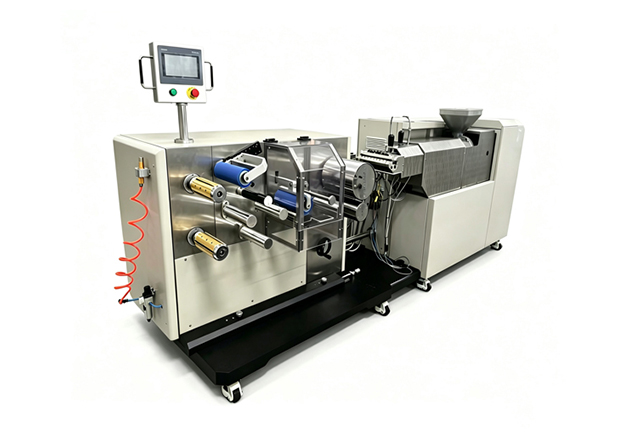
A fluorine material R&D enterprise intended to develop ultra-thin transparent functional ETFE films. It needed to complete molding process verification, sample preparation, optical and mechanical performance testing in the laboratory, and adopted the POTOP corrosion-resistant small precision cast film extruder for small-scale R&D trials.
Core Pain Points of the Customer
-HF acidic gas generated during ETFE melting and decomposition corrodes conventional nitrided steel extrusion components easily, resulting in high trial costs.
-ETFE raw materials are sensitive to moisture. Moisture will directly cause bubbles and pinholes on films, requiring stable feeding and thorough pre-treatment.
-The cooling rate is hard to control. Improper cooling increases crystallinity, raises film haze, reduces light transmittance and leads to finished film wrinkling and warpage.
-For ultra-thin transparent fluorine films, strict standards are required for transverse thickness uniformity and surface cleanliness.
-Small-batch rapid sampling is required to test different ETFE grades and blended formulations, avoiding the high trial cost of mass production lines.
POTOP Corrosion-Resistant Cast Film Experimental Solution
FDSI-25/22P is a customized corrosion-resistant bench-top cast film machine developed for fluoroplastics including ETFE, PFA, FEP and PVDF.
Complete workflow: Loss-in-weight feeding → Hastelloy extrusion and plasticization → melt filtration and pressure stabilization → extrusion through corrosion-resistant coat-hanger die → casting roll cooling and shaping → online thickness monitoring → constant-tension winding.
✅ Anti-corrosion upgrade for all melt-wetted parts
The screw, barrel and die are all made of Hastelloy, resistant to hydrogen fluoride corrosion. It supports repeated long-term small-scale tests of fluoroplastics, avoiding common failures such as equipment corrosion, melt degradation, black spots and metal impurity contamination.
✅ Multi-zone precise temperature control system
Independent copper heating modules with PID precise temperature control stabilize the safe processing window of ETFE and suppress thermal degradation. A water cooling structure for the feeding barrel prevents premature melting and bridging at the feed throat.
✅ Barrier mixing screw optimized for fluoroplastics
The optimized barrier mixing screw achieves sufficient plasticization and melting of ETFE under gentle shear, reducing bubbles and crystal points in the melt and preserving the inherent optical transparency of the material.
✅ High-precision constant-temperature casting roll set + gradient tension control
Independently controlled casting rolls precisely adjust the cooling rate to restrain spherulite growth and guarantee high transparency and low haze. A minor speed gradient between haul-off and winding releases internal stress and eliminates warpage and wrinkles of ETFE films after forming.
✅ Full-process data acquisition
Real-time recording of zone temperature, melt pressure, screw speed, film thickness, roll temperature and haul-off tension. All parameters can be exported and archived to provide reusable process reference for subsequent pilot-scale upscaling.
Test Implementation
-Raw material pre-treatment: ETFE pellets are dried at 110°C for 3 hours to fully remove adsorbed moisture and eliminate bubble defects. The whole machine is preheated until temperature stabilizes before feeding.
-Process debugging: Set the temperature profile of barrel and die step by step, and adjust screw speed, melt pressure, casting roll temperature, haul-off speed and winding tension gradually.
-Continuous casting trial: Extrude stably to produce ultra-thin transparent ETFE films with target thickness of 0.03 mm. Monitor film thickness and surface condition online.
-Sample testing: Test light transmittance, haze, tensile strength and elongation at break of obtained samples.
-Formula iteration: Switch between different ETFE grades and blends with other polymers to compare molding performance and optical properties.
In this trial, stable feeding and extrusion were achieved. The obtained film has a width of 142 mm and thickness of 0.03 mm. The film surface is flat, clean and free of bubbles, crystal points, pinholes and scratches, with minor transverse thickness deviation and well-controlled warpage, meeting the customer’s laboratory testing requirements.
Project Outcomes
Material-adapted anti-corrosion hardware: The dedicated corrosion-resistant unit solves the industry problem of equipment corrosion during ETFE processing, with controllable equipment loss for long-term R&D tests.
Rapid process development: Low material consumption for small-batch tests enables fast grade screening and process window confirmation, greatly shortening the R&D cycle.
Reliable high-standard transparent fluorine film preparation: Effectively control haze, warpage and thickness fluctuation. Samples are qualified for photovoltaic, anti-corrosion and electronic performance tests.
Scalable process data: Traceable extrusion, temperature control and cooling parameters are accumulated to offer reliable support for the customer’s future pilot fluorine film line construction.
Multi-purpose machine: Compatible with film molding of PFA, FEP, PVDF and other fluoroplastics to support diversified fluorine material R&D projects.
The core challenges of high-transparency ETFE fluorine film development lie in anti-corrosion equipment selection, narrow-window temperature regulation, and the balance between cooling crystallization and optical performance.
POTOP corrosion-resistant bench-top precision cast film experimental line targets R&D scenarios of fluorine material enterprises and research institutes. It is developed to tackle the molding pain points of special fluoroplastics. It supports formula development, process validation and sample preparation of single-layer and blended ETFE and other fluororesin films, and serves as core experimental equipment for the preliminary R&D of high-end functional fluorine films.