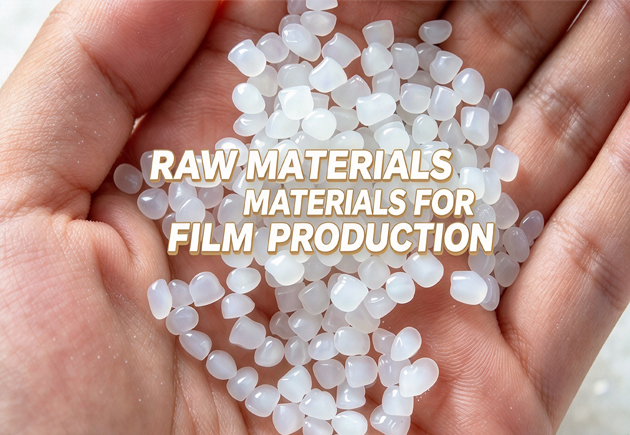
Packaging films, stretch films, optical films, barrier films and other polymer films are mostly derived from the petrochemical industrial chain. Crude oil is fractionated and cracked to produce basic monomers, which are then polymerized into resin pellets such as PE, PP, PET and EVOH. These resins are further processed into various functional films via extrusion and stretching processes.
Film manufacturers commonly face challenges: batch fluctuation of raw resins, defects like gel, fish eyes and stripes caused by uneven dispersion of additives; qualified cast sheets that break, whiten or show uneven thickness during biaxial stretching; unstable barrier and heat shrinkage performance, as well as high scrap cost in pilot production.
POTOP specializes in R&D of lab-scale polymer processing instruments. Combining pelletizing, calendering, casting, film blowing, MDO machine, biaxial stretching tester and rheology characterization equipment widely used in the film industry, we provide a full upstream solution covering resin modification, lab sampling and performance testing.
✅ Application Scope: R&D, incoming inspection, formula development and lab trial for BOPP, BOPET, CPP, PE cling film, multi-layer barrier composite film, functional modified film and special engineering films such as PEEK & PTFE.
Lab-scale Polymer Sample Preparation Equipment (Modification & Sampling, Pre-process for Film R&D)
The general workflow of polymer modification: prepare modified masterbatch via twin-screw compounding first, then produce sheet or film specimens for property testing. Direct lab film forming is also available to predict manufacturability for mass production. POTOP adopts modular design. Customers can purchase single unit or build a complete film R&D laboratory.
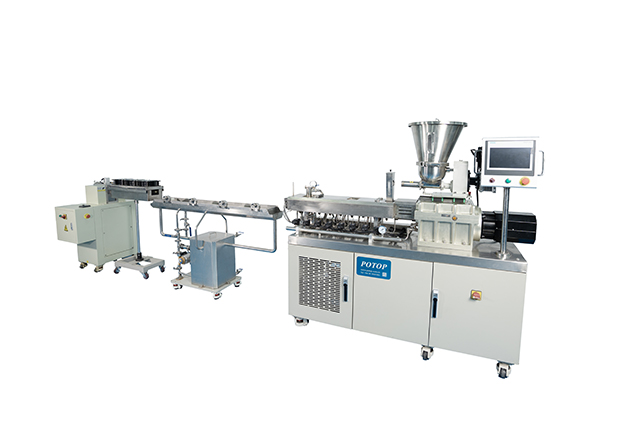
Twin Screw Extruder & Pelletizer
Positioning: The first step of formula modification, core equipment for functional modification of films
Twin-screw compounding is required when film producers incorporate tougheners, antioxidants, slip agents, anti-blocking agents, color masterbatch, barrier fillers and compatibilizers into PP/PE/PET matrix.
Process: Weigh resin pellets and additives according to formula → melting, shearing and compounding at elevated temperature → extrude strands → water / air cooling and haul-off → pelletizing to obtain modified masterbatch.
POTOP Optional Configuration: Loss-in-weight feeder, side feeder for powder fillers and vacuum devolatilization system to remove volatile small molecules, effectively eliminating bubbles, gels and fish eyes on finished films. Compatible with powder and liquid additives for high-filling modification systems.
Applicable Film Types: PP modified compound, PE functional masterbatch, PET toughened compound, EVOH blend, etc. The masterbatch can be fed to subsequent casting, film blowing and biaxial stretching tests.
R&D Value: Verify additive dispersion in advance, avoid stripes, black spots and unstable barrier performance in mass production caused by poor dispersion, and greatly reduce trial-and-error cost.
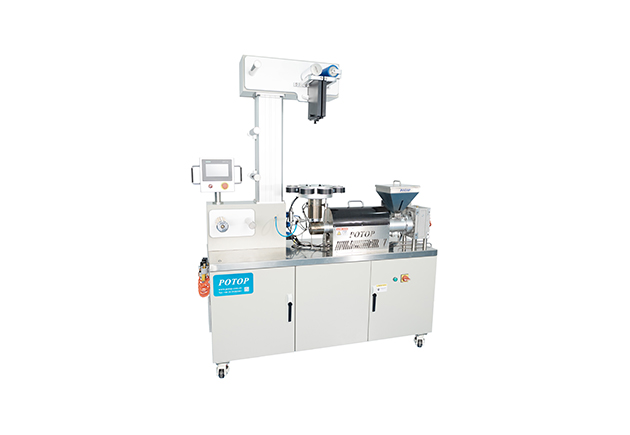
2.Precision Single-screw Film Blowing Machine
Positioning: Produce tubular film specimens, simulating commercial blown film process for LDPE / HDPE / LLDPE (agricultural film, packaging film, water-soluble PVA film)
Raw pellets or modified masterbatch are melted and extruded through an annular die. Compressed air inflates the melt into a bubble, which is hauled and wound into finished film samples. POTOP supplies single-layer and co-extrusion blown film versions.
Suitable Materials: PE series, PP blown film grade, PVA degradable film, etc.
R&D Purposes: Quickly evaluate film transparency, bubble stability, surface defects, slip and anti-blocking effect; compare film-forming performance of different formulas.
Limitation: Not suitable for high-viscosity PET and rigid high-barrier materials. Casting or calendering is recommended for such materials.
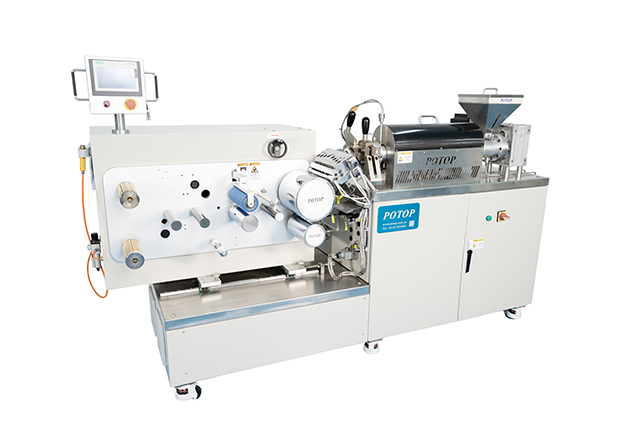
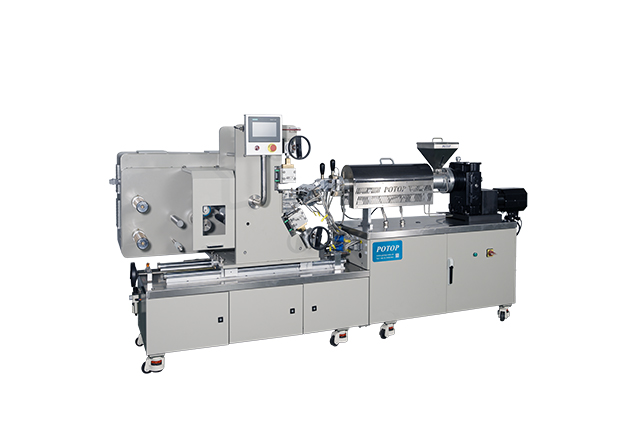
3. Precision Cast Film Machine (Model FDSL)
Positioning: Produce CPP cast film, PET cast sheet, EVOH barrier cast film; prepare precursor sheet for biaxial stretching, supports multi-layer co-extrusion casting
Molten polymer is extruded from a coat-hanger die and adhered to a chilled roll for rapid cooling and solidification to obtain non-oriented, flat and uniform cast sheet / film.
POTOP Advantages: High-precision temperature control, excellent flatness and controllable thickness. Cast sheet is the standard feedstock for POTOP MDO longitudinal stretcher and biaxial stretching tester. High-temperature customized version is available for special engineering films like PEEK and PEN.
Suitable Materials: PP, PET, PE, PA, EVOH; multi-layer co-extrusion available.
R&D Scenarios: Formula development for multi-layer co-extruded barrier film, thickness gradient test of substrate, formulation screening for heat-seal layer, lithium battery separator and special functional film.
4.Precision Calender
Positioning: Prepare sheet and soft film specimens for high-filling and high-viscosity systems
Multiple heated rolls squeeze and spread molten materials. Ideal for formulations with high powder loading.
Suitable Materials: PVC film, highly filled composite, filled masterbatch sheet, elastomer film specimens.
Difference from Casting: Casting relies on die extrusion; calendering forms material through roll gap compression. Calender works better for high-filling, low-flow materials.
5. Biaxial Film Stretcher(Model FOHI / FOCI)
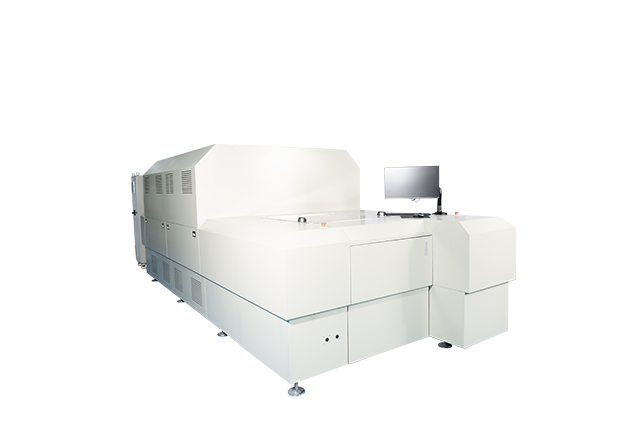
Positioning: Simulate commercial BOPP, BOPET, BOPE, BOPA biaxial stretching process, core instrument for oriented film R&D
Cast sheet goes through preheating, longitudinal stretching, transverse stretching, heat setting and cooling to obtain oriented film. Stretching changes molecular chain orientation, which directly determines tensile strength, modulus, barrier property and heat shrinkage rate.
Common industry pain point: Cast sheet passes lab test, yet breaks, whitens or shows uneven thickness once stretched at larger scale.
POTOP Biaxial Stretcher Features: 4-axis independent servo drive, synchronous / asynchronous stretching switchable; uniform hot air circulation oven with stable temperature control; real-time data collection of tension, temperature and stretch ratio; high repeatability; exportable data for research papers and project reports. Wide-temperature version supports high-temperature stretching of PTFE, PEEK and other special films. It helps define the stretching processing window and screen suitable resins and modified formulas for biaxially oriented films.
Complete R&D & Testing Workflow (Petrochemical Resin → Film Specimen)
Crude oil → Naphtha → PTA / Ethylene Glycol → PET (Ethylene → PE, Propylene → PP) resin pellets
→ Incoming raw material inspection (MFR, DSC, rheology test via POTOP rheology instruments)
→ Formula batching → Twin-screw pelletizing for modified masterbatch
→ Forming option: Casting / Blown film / Calendering
→ Optional process: MDO uniaxial stretching / Synchronous & asynchronous biaxial stretching
→ Finished film performance test (mechanical, optical, barrier, thermal property)
→ Evaluate formula feasibility, lock process parameters, then scale up to mass production
Workflow overview: Twin-screw for compounding and modification; casting / blowing / calendering for film sample preparation; MDO and biaxial stretcher for orientation simulation; rheology and characterization instruments for quantitative index measurement. The full POTOP system validates polymer materials from lab trial.
Crude oil price fluctuation transfers downstream to resin, and batch variation of resins eventually disturbs film production stability. If film factories only test finished films, problems are found after production. It is a more efficient way to verify resin and modification at upstream stage with POTOP modular lab instruments to replicate production process, reduce pilot waste and stabilize film quality.
POTOP develops the full set of modular polymer sample preparation and rheology testing systems. Widely adopted by universities, research institutes, film R&D centers, masterbatch manufacturers and advanced material enterprises. Flexible combination accelerates formula iteration, incoming inspection and new product development, bridging lab-scale trial and industrial production.