
Core Properties of PMMA Film Material
Polymethyl Methacrylate (PMMA) is a core transparent polymer material widely used in high-end optical applications. It boasts an exceptional light transmittance of 92%–93% and superior optical clarity. As an amorphous polymer, PMMA features excellent dimensional stability and outstanding weather resistance, and rarely suffers from yellowing or aging after long-term service. It also delivers good processability and high surface gloss.
Thanks to its combined merits of light weight, high transparency, biocompatibility and easy modification, PMMA film is extensively applied in optical displays, medical devices, high-end packaging, flexible electronics and other fields. It is also an ideal functional film to replace traditional glass substrates and realize lightweight design of components.
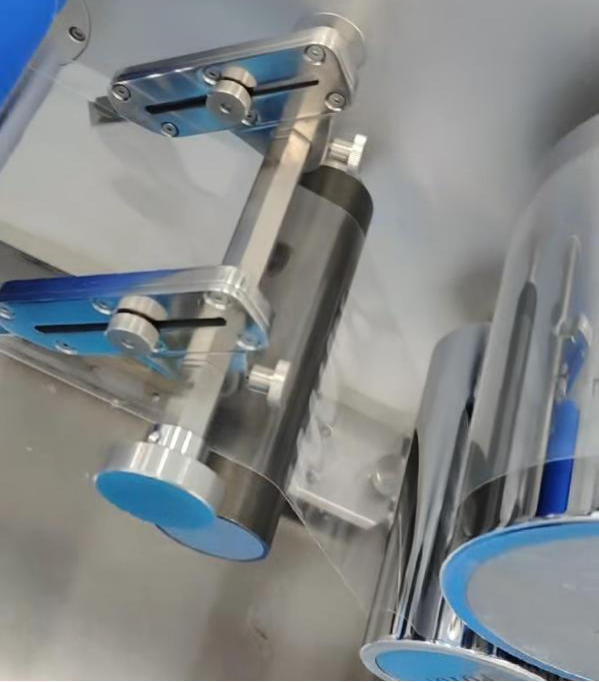
Benchtop Extrusion Cast Film Machine: Precision Equipment for PMMA Film Forming
PMMA melt is highly sensitive to processing conditions and prone to internal stress. Defects such as silver streaks, bubbles and uneven thickness often occur during forming. To address these challenges, POTOP provides a dedicated lightweight forming solution with its benchtop precision extrusion cast film machine. Developed for laboratory R&D, process commissioning and small sample preparation, this equipment enables stable plasticization and precision cast film forming for both neat PMMA and modified PMMA formulations. High-quality film samples can be produced without consuming large quantities of raw materials.
Practical Forming Test Results
With standard pre-drying treatment, PMMA raw materials can achieve continuous and stable cast film forming on this machine. Uniform ultra-thin optical films with a thickness of 75 μm can be produced precisely. The finished films feature a smooth and clear surface free of crystal points, silver streaks or wrinkles, which fully demonstrates the equipment’s excellent forming stability and process controllability. It serves as reliable equipment support for formula optimization and process finalization of PMMA optical films.
Core Forming Characteristics & Optimization Principles of PMMA Film
PMMA optical films impose stringent requirements on plasticization uniformity, temperature stability and forming stress control. POTOP’s benchtop cast film machine enables full-process regulation, covering raw material pretreatment, melt plasticization and cooling & setting, to guarantee superior optical performance of finished films.
●Precise Temperature-controlled Plasticization for Superior Optical Quality
Graded temperature control is adopted in line with the rheological properties of PMMA, realizing gentle and uniform melt plasticization and avoiding material degradation and yellowing caused by local overheating. Optimized die surface temperature regulation effectively relieves internal stress generated during film forming, and greatly improves light transmittance, surface gloss and mechanical consistency of final products, so as to eliminate optical defects from the process perspective.
●Steady Forming to Avoid Common Defects
The equipment adopts coordinated stable extrusion and traction technology. Melt is conveyed at a moderate shear rate to reduce shear degradation of PMMA molecular chains. By synchronizing forming speed and extrusion pressure, uniform material output and flat film formation are ensured. It effectively solves common problems including film warpage, thickness deviation and poor demolding, fully meeting the production requirements of high-precision optical films.
●Raw Material Pretreatment: Quality Control at the Source
PMMA is highly hygroscopic. Moisture contained in raw materials will cause bubbles, silver streaks and increased haze in finished films. Standard high-temperature pre-drying is an essential pre-process for both laboratory R&D and industrial mass production, which thoroughly removes moisture from raw materials and ensures the production of highly transparent, premium-quality films.
Key Process Advantages of the Equipment
Custom-developed for optical film R&D, this benchtop precision cast film machine features strong process adaptability and perfectly accommodates the sensitive forming characteristics of PMMA. It delivers stable operation and excellent stress relief. Films produced are uniform in thickness and consistent in optical performance, with forming rules highly replicable for industrial cast film production.
Compact and lightweight, the machine features low material consumption and easy commissioning, supporting rapid trial iteration for multiple batches and formulas. It not only meets the process verification demands of university research and corporate new product development, but also optimizes mass production processes in advance, effectively shortening the cycle from laboratory formula development to industrial mass production of PMMA optical films.
Application Scenarios
●High-end Optical Display
Featuring high light transmittance, scratch resistance and great weatherability, PMMA film is widely used as protective films and light guide substrates for display devices. Combined with precision cast film forming and multi-layer co-extrusion modification technology, its impact resistance and anti-glare performance can be further enhanced. It is gradually replacing traditional glass substrates to achieve lightweight and ultra-thin upgrading of display components.
●Medical Packaging & Devices
PMMA has excellent biocompatibility and sterilization resistance, making it suitable for manufacturing sterile medical packaging films. Supported by the equipment’s high-precision thickness control, it can stably produce medical films with uniform thickness and consistent barrier properties, providing reliable material solutions for sterile protection and sealed packaging of medical devices.
●Smart Wearables & Flexible Electronics
The 75 μm ultra-thin PMMA film stands out for good toughness, high light transmittance and light weight, and can be used as optical substrates and protective films for flexible displays and smart wearable devices. With targeted modification, it balances flexural performance and impact resistance, catering to the R&D needs of innovative flexible electronic devices.
Industry Outlook
With the advancement of precision forming technology, PMMA films are evolving toward ultra-thin structure, multi-functionality and composite modification. Leveraging Putong’s precision cast film experimental equipment, co-extrusion and compound modification of PMMA with PC and other materials can be realized to make up for the performance limitations of single materials. A variety of multi-functional optical films with impact resistance, electrical conductivity, thermal conductivity, anti-glare and other properties can be developed.
In the future, backed by accurate experimental processes and professional equipment, PMMA films will be further applied in high-end fields such as new energy, precision optoelectronics and aerospace, continuously expanding the application scope of polymer optical materials.