
This article illustrates the inherent connection between petrochemical industry and polymer materials, detailing how crude oil is refined into synthetic polymers. It also discusses the industrial shift from traditional petro-based plastics to eco-friendly bio-based polymers and introduces professional polymer testing and processing solutions for high-performance functional film R&D.
Crude oil cannot be directly processed into polymer products. Through fractional distillation and high-temperature cracking, crude oil is decomposed into basic small-molecule monomers including ethylene, propylene, and benzene. These core building blocks undergo addition polymerization and condensation polymerization to form long-chain and network macromolecular structures, producing three major synthetic material categories: plastic resins such as PE and PP, synthetic rubber including styrene-butadiene rubber, and synthetic fibers such as polyester and acrylic fiber.
Although crude oil contains high-molecular hydrocarbons, these components are not suitable for direct polymer production. Precise cracking and purification into standard monomers are essential for industrial polymerization. Thanks to mature petrochemical manufacturing systems, hundreds of millions of tons of polymers are mass-produced globally every year. Low-cost and stable monomer supply underpins the rapid development of modern polymer industries. In return, the booming demand for high-performance polymer materials continuously drives the technological upgrading of petroleum deep processing, forming a mutually promotive industrial ecosystem.
Nevertheless, petroleum is a non-renewable fossil resource. Stricter environmental regulations and global carbon neutrality goals have exposed the limitations of traditional petro-based polymers. In this context, bio-based polymers represented by PLA and PHA have emerged as a vital green transition solution. Manufactured from renewable biomass resources, bio-based polymers enable compostable degradation and effectively reduce white pollution. Despite current gaps in production cost and mechanical performance, they represent the core sustainable development direction of the polymer industry.
Polymer pellets produced by monomer polymerization require professional forming and processing equipment to become end products. A wide range of high-value products, including medical packaging films, food packaging films, lithium battery separators, photovoltaic encapsulation films, 5G functional films, aerospace special films, and marine engineering protective materials, rely on advanced processes such as extrusion, casting, film blowing, calendering, biaxial stretching, and multi-layer co-extrusion compounding. The material rheological properties, processing stability, and technical parameters directly determine the final quality and service performance of functional polymer films.
POTOP Co., Ltd. focuses on the R&D and manufacturing of professional polymer experimental and processing equipment, providing full-process solutions for polymer laboratory testing and pilot-scale production. Our rheological characterization equipment includes torque rheometers, capillary rheometers, and pressure filter testers to accurately evaluate material processing performance. Our small precision processing equipment covers casting machines, calenders, single/multi-layer co-extrusion film blowers, multi-layer co-extrusion casting and calendering lines, in-mold and out-mold compounding machines, and film biaxial stretching testers.
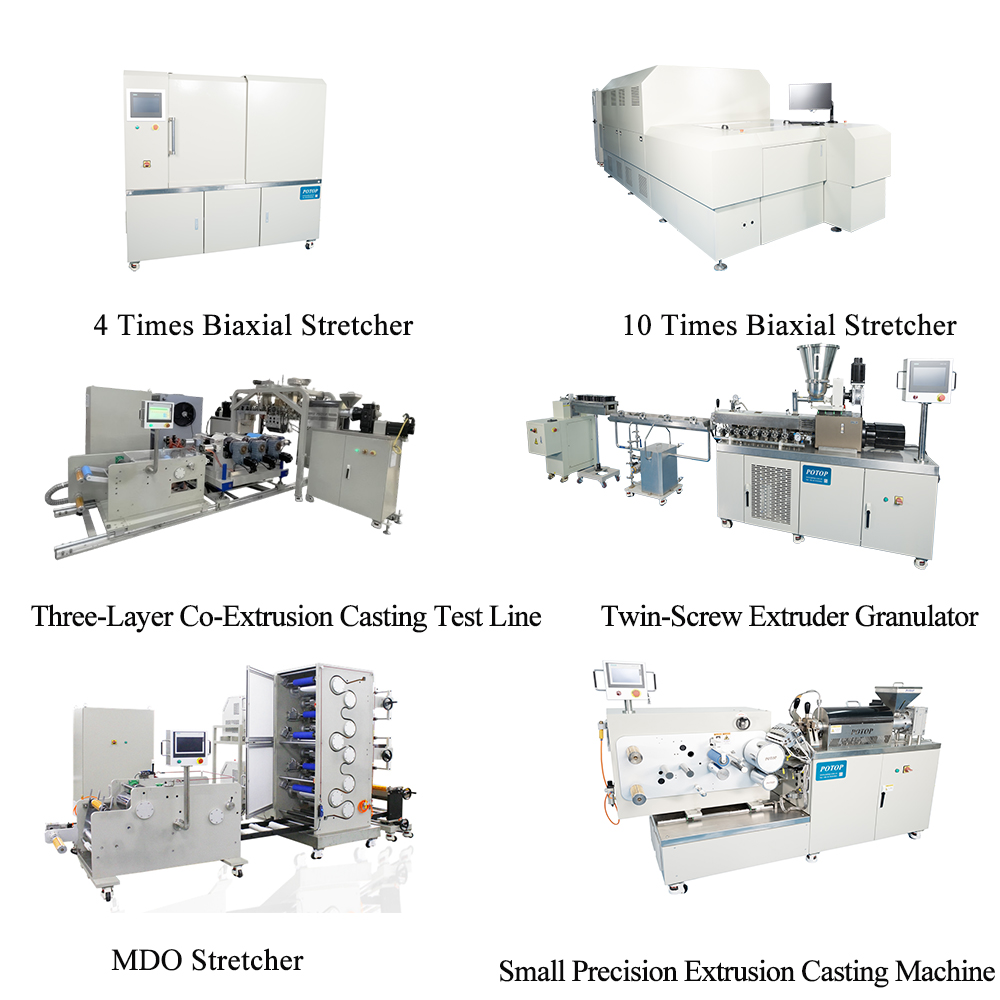
POTOP’s equipment supports petro-based polymer modification, bio-based material formulation optimization, and trial production of high-end functional films. We fully meet the R&D, process optimization, and pilot production demands of universities, research institutes, and new material enterprises. Committed to promoting the transformation from traditional petrochemical polymers to green bio-based materials, Potop empowers technological innovation in lithium batteries, photovoltaics, medical hygiene, 5G communication, aerospace, and other high-end industries.