
Basic Definition of TPU Material
Core Performance Characteristics of TPU
Boasting comprehensive outstanding properties, TPU stands out as a preferred high‑performance elastic substitute material. Its key advantages are listed below:
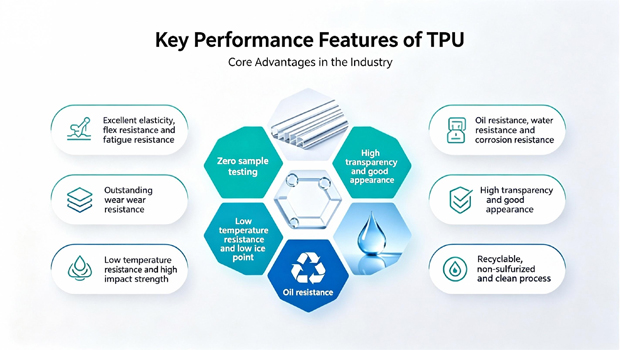
●High elasticity, flex‑fatigue resistance: It covers a broad hardness range from 60A‑95A to 70D. Featuring excellent rebound performance, low permanent deformation and high crack resistance under repeated stretching and bending, it delivers far longer flex‑life than ordinary rubber, making it ideal for flexible and dynamically‑moving structures.
●Superior wear resistance: Ranked among top‑tier wear‑resistant polymer materials, TPU outperforms rubber, PVC and EVA dramatically in abrasion resistance. It is suitable for wear‑proof accessories, shoe soles, transmission parts, industrial seals and robot buffer structures.
●Excellent low‑temperature & impact resistance: It retains its toughness and elasticity at temperatures as low as ‑40℃ without brittle fracture, well‑suited for outdoor equipment, cold‑chain materials, vehicle‑mounted components and outdoor flexible robot parts.
●Oil, corrosion and hydrolysis resistance: Polyether‑based and polyester‑based TPU deliver premium hydrolysis‑resistance and oil/acid‑alkali resistance respectively. They achieve extended service life under humid, oily and corrosive working conditions, and are widely used in new‑energy wire harnesses, oil hoses and protective sealing sleeves.
●High transparency & premium surface finish: High‑grade transparent TPU offers high light transmittance, low haze and zero crystal spots or streaks. It can be fabricated into high‑definition protective films, waterproof breathable membranes and transparent structural components, balancing aesthetic appearance and practical performance.
●Recyclable & eco‑friendly clean processing: As a thermoplastic material, TPU can be recycled and re‑processed. No vulcanization or waste‑gas emission is required, which complies with the low‑carbon manufacturing trend, and makes it an ideal upgraded alternative to traditional vulcanized rubber.
Key Challenges in TPU Processing
Despite its excellent performance, TPU is highly sensitive to processing conditions and is widely recognized as a hard‑to‑tune material in the industry. Its main pain points are summarized as follows:
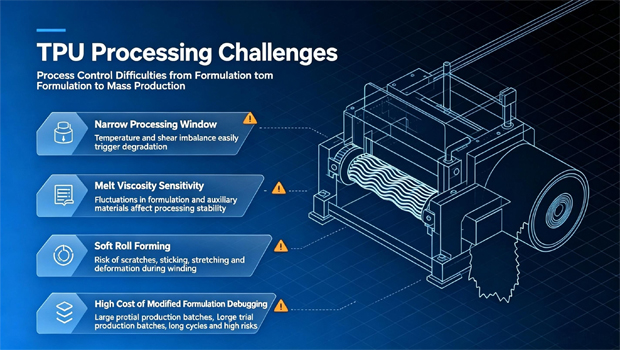
●Extremely narrow processing window: Excessive temperature or shear force triggers yellowing, thermal degradation and molecular‑chain breakage; insufficient temperature leads to poor plasticization and abundant crystal spots, leaving very low fault tolerance for processing parameters.
●High melt‑viscosity sensitivity: After fillers, flame retardants and other functional additives are incorporated, melt fluidity fluctuates sharply, which easily causes unstable discharge, uneven thickness and large batch‑to‑batch discrepancies.
●Difficult flexible‑film forming: Soft TPU films are hard to control in tension during production, prone to roller‑sticking, tensile deformation, wrinkling and uneven winding.
●High trial‑and‑error cost for modified formulations: Conventional on‑machine pilot production features long cycles, high material loss and elevated process risks, slowing iteration of new formulations.
Exclusive R&D & Molding Solutions for TPU
To address the pain points of TPU, including its narrow processing window, shear sensitivity, difficult flexible‑film forming and costly formulation validation, POTOP Instrument provides an integrated equipment solution covering rheological testing, lab‑scale formulation trials and film forming. It helps manufacturers quickly finalize stable processes and cut trial‑and‑error expenses.
Torque Rheometer | Formulation Mixing & Thermal‑Stability Test: It simulates real‑world processing shear and temperature environments, to evaluate TPU mixing performance, melt stability and thermal degradation resistance. It enables rapid verification of modified‑formula compatibility and avoids mass‑production defects at an early stage.
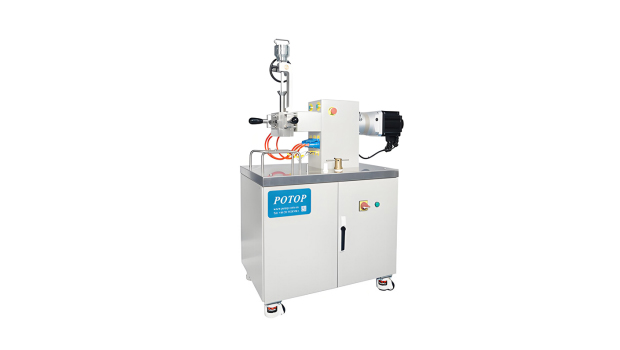
Capillary Rheometer | Precise Calibration of Processing Window: It measures TPU melt viscosity, flow behavior and melting‑plasticization parameters, generates rheology curves, and pinpoints the optimal temperature and shear‑force window for extrusion, supplying solid data support for mass‑scale manufacturing.
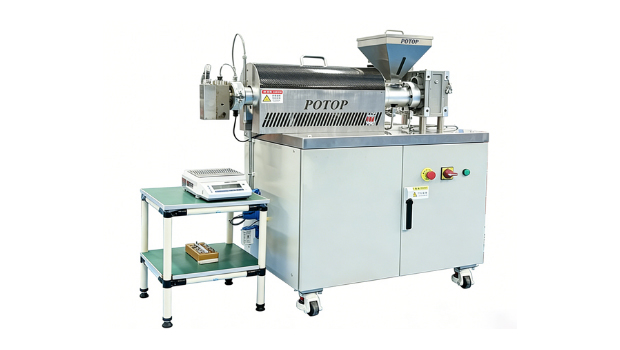
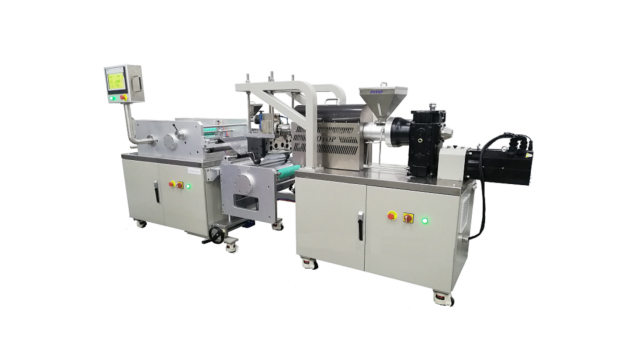
Compact Precision Extrusion‑Cast Film Pilot Line | Specialized Lab‑Scale Equipment for TPU Films: Optimized for soft‑TPU‑film characteristics, this system is equipped with high‑precision temperature control and servo‑driven tension control modules. It solves common defects such as wrinkling, tensile deformation, uneven thickness and roller‑sticking, and allows fast sample‑making and process validation for various modified TPU films.
Main Application Scenarios of TPU
Domestic modified TPU materials are now widely deployed across multiple fields: new‑energy‑vehicle wire‑harness sleeves & battery buffer structures, flexible joints and protective components for humanoid robots, medical breathable films, high‑end waterproof membranes, 3D‑printing filaments, premium footwear, transparent electronic protective films, industrial wear‑resistant sealing accessories and more.