
FEP (Fluorinated Ethylene Propylene, commonly referred to as F-46, full name: perfluorinated ethylene-propylene copolymer) is a modified copolymer of PTFE. It fully retains the superior chemical resistance, high/low temperature resistance and insulating properties of fluoroplastics, while completely solving the industry bottleneck that PTFE cannot undergo melt processing. This article compares the core performance differences between FEP and PTFE, focuses on extrusion and cast film processes, sorts out practical application pain points in cable insulation and specialty film sectors, analyzes common forming defects and improvement strategies, and offers professional references for material selection and production process commissioning.
What is FEP Fluoroplastic
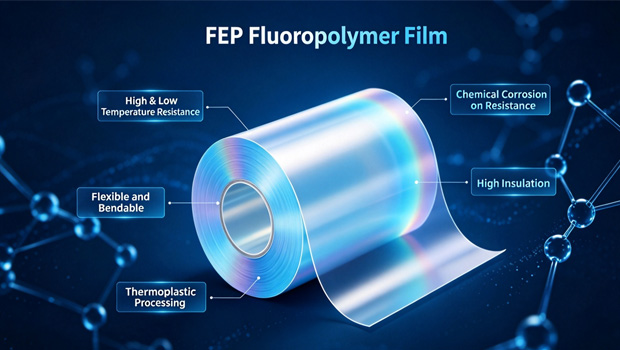
FEP, Fluorinated Ethylene Propylene, is a copolymer of tetrafluoroethylene and hexafluoropropylene, classified as thermoplastic perfluorinated fluoroplastic. Its key physical properties: melting point 255–265℃, density approx. 2.14–2.17 g/cm³, dielectric constant around 2.1 under normal conditions. Stable fundamental physical properties fit large-scale manufacturing.
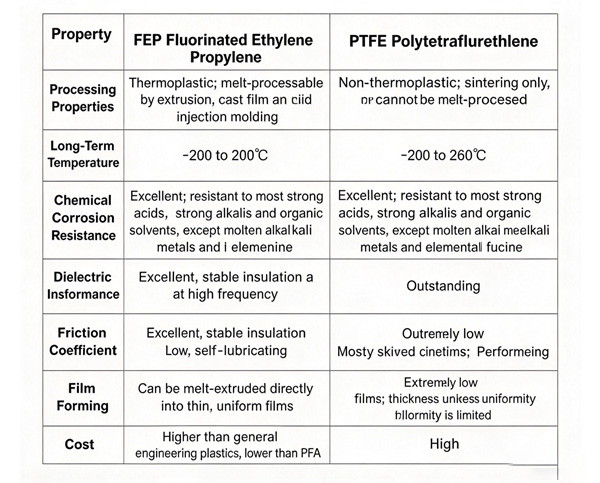
PTFE, known as “the King of Plastics”, delivers top comprehensive performance, yet it is non-melt-processable and can only be formed via sintering. It features long processing cycles and cannot be used for thin-wall films or complex cable extruded products, with massive limitations in mass production. As a melt-extrudable perfluoroplastic, FEP retains most of PTFE’s premium characteristics and supports multiple thermoplastic forming processes such as injection molding, extrusion, cast film and blown film. It is a core representative of fluoroplastics balancing high performance and processability
Core Performance Comparison: FEP vs PTFE
Main Industrial Applications of FEP
●Insulation & Sheathing for High-Temperature Wires and Cables
FEP’s primary application lies in high-temperature special wires and cables for aerospace, instrumentation and high-temperature equipment wiring. It features high temperature resistance, stable insulation, oil & corrosion resistance and flame retardancy, remaining flexible without brittling under alternating high and low temperatures.
●Specialty Cast Fluorine Films
FEP cast films are used for anti-corrosion linings, release films, photovoltaic encapsulation and flexible substrates & anti-corrosion gaskets. Compared with PTFE skived films, FEP cast films enable continuous mass production with uniform thickness, better flatness and transparency.
●Chemical Anti-Corrosion Components
It can be extruded into pipes, liners and fittings, or injection molded into small anti-corrosion parts for various strongly corrosive working conditions.
Common Pain Points in FEP Extrusion & Cast Film Production
Pain Point 1 Poor thermal stability; prone to decomposition and corrosive gas release at high temperatures
The regular processing temperature range for FEP extrusion is 300–380℃. Excessive temperature or prolonged material residence inside the screw will trigger thermal decomposition, releasing corrosive gas like hydrogen fluoride, which corrodes screws and die heads and causes defects including bubbles, pinholes and black streaks on finished products.
✅ Solutions: Strict temperature control to avoid overheating; timely purging during shutdown to prevent material stagnation; anti-corrosion protection for equipment and regular carbon deposit cleaning on die heads.
Pain Point 2 Gel specks, fish eyes and uneven thickness in cast films
Mainly caused by gel impurities in raw materials, contaminated die heads or uneven temperature; the most frequent defects of FEP films.
✅ Solutions: Fully dry raw materials; install precision filtration; clean die heads periodically; stabilize cast roll temperature and cooling rate.
Pain Point 3 Dull surface, pits and cracking in extruded cable products
FEP melt is sensitive to shear rate. High-speed extrusion easily leads to melt fracture, dull rough surface and cracking.
✅ Solutions: Properly control extrusion speed, optimize die draw ratio; match temperature of each zone to stabilize melt fluidity.
Pain Point 4 Stress cracking induced by residual internal stress in finished parts
FEP boasts excellent low-temperature toughness, yet residual internal stress from forming may cause cracking of films and sheaths under temperature cycling.
✅ Solutions: Anneal finished products to eliminate internal stress; avoid overly thin wall thickness and stress concentration in product design.
Fluoromaterial Selection Reference Table
① Melt extrusion / cast film mass production, balanced performance & cost → FEP
② Long-term service at 240–260℃, melt processing required → PFA
③ Ultimate temperature resistance up to 260℃, sintering forming acceptable → PTFE
④ High mechanical strength & radiation resistance service conditions → ETFE; FEP/PFA preferred for high-frequency low-loss electrical applications
FEP addresses PTFE’s incapability of melt processing, combining temperature resistance, corrosion resistance, high insulation and mass producibility. It is widely adopted in special cables, fluorine films and chemical anti-corrosion fields. It has a narrow processing window and imposes high requirements on temperature control, equipment anti-corrosion, filtration and cleaning. Stable processing temperature, reduced material residence and regular equipment maintenance can effectively mitigate defects including bubbles, gel specks, melt fracture and stress cracking.