
Polypropylene (PP) is a widely used polymer raw material. OPP, BOPP and CPP are finished films manufactured from PP pellets. They differ greatly in manufacturing process, mechanical properties and application scenarios.
What are the differences between PP, OPP, BOPP and CPP films?
PP
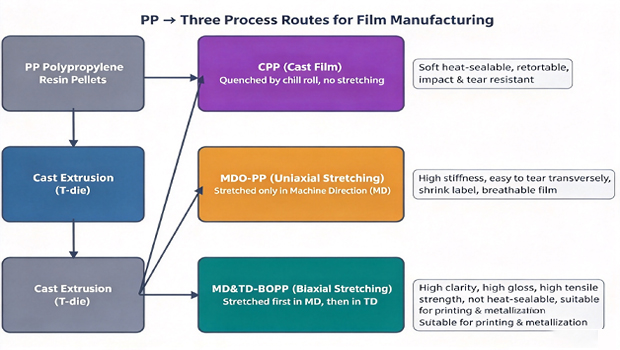
Polypropylene resin pellets, the raw material, not a film product. It is the base feedstock for producing OPP, BOPP and CPP films.
CPP – Cast Polypropylene Film
Manufactured via T-die extrusion. The molten PP is cast onto a chilled roll and quenched directly, without stretching.
Features: Soft texture, excellent ductility and superior heat-sealing performance. RCPP retort-grade CPP can withstand high-temperature sterilization. High transparency and smooth surface. Tensile strength is lower than BOPP, while it performs better in impact resistance and tear resistance.
Typical applications: Heat-sealing layer for laminated packaging, retort pouches, food flexible packaging.
OPP – Uniaxially Oriented Polypropylene Film
Only stretched along the machine direction (MD). Molecular chains orient in one single direction, so it tears easily in the transverse direction (TD).
⚠️Industry Note: Many buyers colloquially call BOPP “OPP”. They are completely different in process. Distinguish uniaxial OPP from biaxial BOPP during material selection.
Typical applications: Adhesive tape substrate, simple labels. Less used in conventional packaging nowadays.
BOPP – Biaxially Oriented Polypropylene Film
Extrude thick cast sheet first, then stretch sequentially or synchronously in both MD & TD directions. Molecular chains orient along two axes.
Features: Rigid film, high gloss and clarity, crisp sound when crumpled. General homopolymer BOPP has nearly no heat-sealing property. Corona treatment is required before printing to improve ink adhesion. High tensile strength, low elongation, average tear resistance.
Typical applications: Printing packaging, metallized substrate, BOPP capacitor film, holographic anti-counterfeit film, thermal lamination film, BOPP synthetic paper. It is the most versatile high-end PP film.
High-value Tracks of PP-based Functional Films
Conventional packaging films face fierce competition. The profit growth of PP materials mainly comes from specialty functional films for electrical & electronics and advanced new energy materials. These are the core R&D focuses for material enterprises.
1. BOPP Capacitor Film (Highest added value)
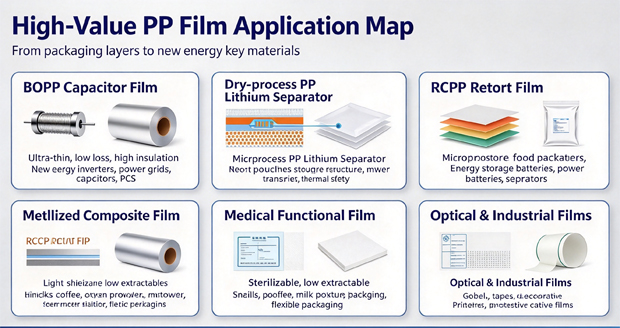
Dielectric medium for film capacitors, widely used in EV inverters, PV inverters, power grid and high-end consumer electronics.
Technical requirements: Ultra-thin grade down to 2~4 μm, also 5~6 μm medium thickness available. Extremely strict requirements on dielectric performance and purity. Crystals and foreign contaminants must be controlled at ultra-low ppm level.
Industry status: High-end ultra-thin electrical BOPP film has long been monopolized by a small number of manufacturers in Europe and Japan. It represents the highest technical barrier of the BOPP industry.
R&D challenge: Narrow process window for uniform cast sheet and ultra-thin stretching. Biaxial stretching tester and FPV filter pressure value tester are essential to evaluate raw material cleanliness and stretching parameters.
2. Dry-process PP Microporous Lithium-ion Separator
Function: Isolate cathode and anode while allowing lithium-ion transport to guarantee battery safety and electrochemical performance.
Process routes: PP-based dry separator includes uniaxial stretching route and β-crystal biaxial stretching route. Key indicators: pore size uniformity and puncture strength.
Note: Production lines for dry separators are not interchangeable with regular BOPP production lines.
Market driver: Rapid expansion of power battery and energy storage market, one of the hottest new energy tracks for PP polymers.
R&D challenge: β-crystal regulation, stable cast sheet quality and precise stretch ratio control. Suitable for lab trials with MDO machine and biaxial stretching tester.
3. Pharmaceutical & Medical Packaging Films
Including modified PP composite blister films, sterile packaging films and PP IV bag films. Some modified PP grades are developed as alternative materials for cold-form aluminum.
Core requirements: Sterilizable by steam or gamma irradiation. Strict pharmaceutical packaging registration certification, high customer stickiness.
4. High-performance Functional Food Packaging Films (Modified BOPP / CPP)
Functional modification based on base BOPP and CPP: Metallized films (VMBOPP / VMCPP) for oxygen & moisture barrier (milk powder, coffee, snacks), easy-peel films, anti-fog lidding films for fresh produce, high-temperature resistant RCPP retort films, mono-material recyclable PP packaging, complying with global plastic reduction and circular economy regulations.
R&D support: Cast extrusion line for CPP substrate development; torque rheometer to characterize flow behavior of modified PP compounds.
5. Hygiene Nonwovens & Breathable Substrates
Spunbond / meltblown PP nonwovens (meltblown fabric for masks), SMS composite materials. Premium hygiene products (diapers, sanitary napkins) adopt spunbond PP nonwoven + breathable film structure.
6. Optical & Industrial Specialty BOPP Films
BOPP synthetic paper (direct print without lamination for labels, maps, advertising), matte film, pearlescent film, holographic anti-counterfeit film, thermal pre-coating film. Widely used in brand packaging, anti-counterfeit printing and graphic lamination.
POTOP Lab-scale R&D Equipment for PP Film Development
For formulation and process development of modified PP, BOPP capacitor film, CPP cast film, dry PP lithium separator and optical BOPP film, POTOP provides a full portfolio of polymer processing and testing lab equipment. It helps manufacturers, universities and research institutes carry out formulation iteration, cast sheet validation and stretching sampling efficiently.
✅ Film Stretching Equipment: MDO machine, TDO machine, biaxial stretching tester (for BOPP and dry separator development, adjustable stretch ratio, temperature and speed)
✅ Extrusion Line: Cast film extrusion system, sheet extrusion line for CPP film and thick cast sheet for stretching
✅ Rheology & Filtration Testing: Torque rheometer, capillary rheometer, FPV filter pressure value tester, to characterize processability of modified PP and impurity / gel level
✅ Compounding & Auxiliary Units: Internal mixer, two-roll mill, compression molding press, winding & calendering auxiliary machines
From compounding, cast extrusion, sheet casting, biaxial stretching to rheology and purity inspection, POTOP delivers one-stop lab polymer equipment, accelerating commercialization of advanced PP functional films and shortening your R&D cycle.